The Future of Large Language Models in Scientific Research
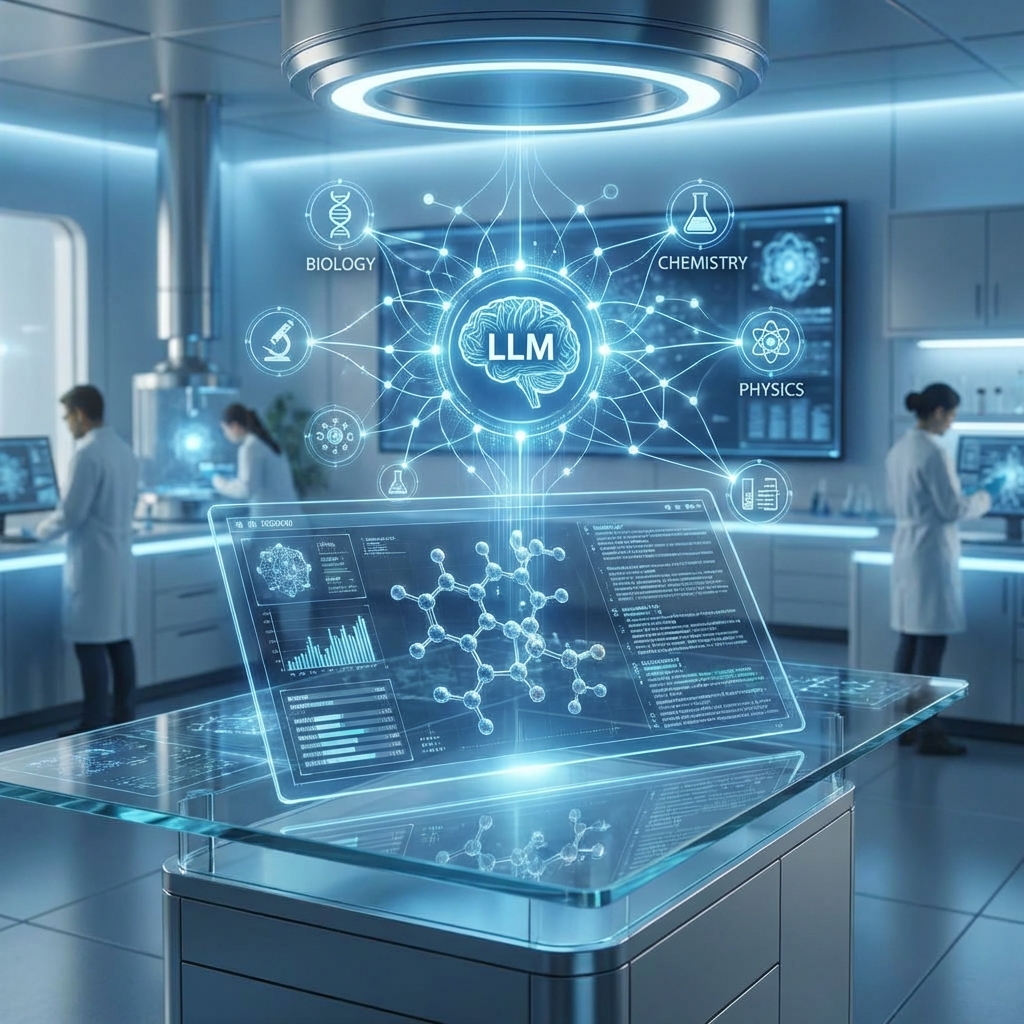
Large Language Models are no longer just impressive demos—they're becoming genuine tools for scientific discovery. From literature review to hypothesis generation, LLMs are reshaping how researchers work. But what can they actually do today, and what are their limitations?
LLMs as Research Assistants
Literature Review and Synthesis
Perhaps the most immediate application is helping researchers navigate the exponentially growing body of scientific literature. With over 5 million new papers published annually, no human can keep up.
# Example: Using LLMs for literature synthesis
prompt = """
Analyze these 10 papers on continual learning and:
1. Identify the main approaches (replay, regularization, architecture)
2. Compare their reported performance on Split CIFAR-100
3. Highlight gaps in the current research
4. Suggest promising future directions

Papers:
{paper_abstracts}
"""

response = llm.generate(prompt)
LLMs excel at identifying patterns across large document sets, synthesizing findings, and generating structured summaries.
Code Generation and Analysis
Modern LLMs can generate, explain, and debug scientific code:
# LLM-assisted scientific computing
prompt = """
Write a PyTorch implementation of the EWC (Elastic Weight Consolidation)
regularization loss for continual learning. Include:
- Fisher information matrix computation
- The quadratic penalty term
- Clear documentation

The implementation should be compatible with any PyTorch model.
"""

# The LLM generates working, documented code
This accelerates the research-to-implementation pipeline, especially for researchers who are domain experts but not programming specialists.
Hypothesis Generation
More speculatively, LLMs can help generate research hypotheses by connecting disparate findings:
Input: "Mechanism X improves learning in task A, Mechanism Y helps in task B"
LLM: "Have you considered combining X and Y? The interaction might produce
      synergistic effects because [reasoning based on related literature]"
Real-World Applications
Drug Discovery
Pharmaceutical companies are using LLMs to:
- Predict molecular properties from structure descriptions
- Generate novel compound candidates
- Analyze clinical trial reports
# Molecular property prediction via LLM
prompt = f"""
Given the SMILES representation: {smiles_string}
Predict the following properties:
1. Solubility (LogS)
2. Lipophilicity (LogP)
3. Toxicity risk factors
4. Potential drug-drug interactions

Provide confidence levels for each prediction.
"""
Materials Science
LLMs assist in:
- Extracting synthesis recipes from papers
- Predicting material properties
- Suggesting novel material combinations
Climate Science
Applications include:
- Analyzing climate model outputs
- Synthesizing IPCC reports
- Generating accessible explanations of complex phenomena
Limitations and Risks
Hallucination in Scientific Contexts
LLMs can generate plausible-sounding but incorrect scientific claims. This is particularly dangerous in research where errors can propagate:
LLM Output: "The ADAM optimizer converges at a rate of O(1/√T) for
            non-convex functions (Smith et al., 2019)"

Reality: This citation doesn't exist, and the convergence claim
         is an oversimplification.
Mitigation strategies:
- Always verify LLM-generated citations
- Cross-reference claims with primary sources
- Use retrieval-augmented generation (RAG) grounded in real papers
Reasoning Limitations
Current LLMs struggle with:
- Multi-step mathematical proofs
- Causal reasoning vs. correlation
- Novel experimental design
- Uncertainty quantification
# Example of LLM reasoning failure
question = "If A causes B, and B correlates with C, does A cause C?"

# LLMs often incorrectly answer "yes" despite this being a
# classic causal inference fallacy
Bias in Scientific Literature
LLMs trained on existing literature inherit:
- Publication bias (positive results overrepresented)
- Geographic and institutional biases
- Historical misconceptions
Best Practices for Researchers
1. Use LLMs as Assistants, Not Oracles
# Good: LLM generates initial draft, human reviews and verifies
draft = llm.generate(prompt)
verified_content = human_review(draft, check_citations=True)

# Bad: Blindly trusting LLM output
final_paper = llm.generate("Write a paper about X")
2. Implement Verification Pipelines
def verify_scientific_claim(claim, llm):
    """
    Multi-step verification of LLM-generated claims
    """
    # Step 1: Ask LLM to cite sources
    sources = llm.generate(f"Provide sources for: {claim}")

    # Step 2: Verify sources exist
    valid_sources = [s for s in sources if check_exists(s)]

    # Step 3: Cross-reference with actual source content
    for source in valid_sources:
        content = fetch_paper(source)
        if not llm.verify_claim_in_context(claim, content):
            return False, "Claim not supported by cited source"

    return True, valid_sources
3. Document LLM Usage
Transparency about AI assistance is increasingly expected:
Acknowledgments:
"This manuscript benefited from AI-assisted literature review
and code generation using [Model Name]. All AI-generated content
was verified by the authors."
The Future: AI Scientists?
Could LLMs eventually conduct independent research? The path might look like:
Current State (2024):
- Literature review assistance
- Code generation
- Writing assistance
Near Future (2025-2027):
- Autonomous hypothesis generation
- Experiment design suggestions
- Automated replication studies
Longer Term (2028+):
- Closed-loop research systems
- AI-designed experiments
- Novel scientific discoveries
However, fundamental challenges remain:
- True scientific creativity vs. pattern recombination
- Grounding in physical reality
- Ethical oversight and accountability
My Perspective
As a PhD researcher, I use LLMs daily—for code debugging, literature discovery, and writing refinement. But I've learned their limitations:
- Trust but verify: Every claim needs checking
- LLMs excel at iteration, not origination: They're great at refining ideas, less so at generating truly novel ones
- The human remains essential: Scientific judgment, ethical consideration, and creative insight are still uniquely human
The most effective researchers will be those who learn to collaborate with AI while maintaining critical thinking. LLMs are powerful tools, but like any tool, their value depends on the skill of the user.
Interested in AI for science? Check out my research on multi-agent systems and synthetic data generation at Google Scholar.